Saturday, 13 July 2013

Lake Como, Villa Carolotta & Bellagio

Lake Como, Villa Carlotta, Bellagio
Villa Carlotta
The famous Villa Carlotta is found in the shore side town of Tremezzo on Lake Como.  Our bus trip took us from Stresa back along the motorway towards Milan then wound our way north through the precipitous hill roads and tunnels to Como.  

The 17th century villa, which is full of statues including some very famous masterpieces by Canova, Thorvaldson and Hayez, is set in 70,000 square metres of Italianate gardens with fountains, and pergolas, groves of lemon and espaliered roses.  

It is famous for its azaleas and rhododendrons which flower in spring but they had all finished flowering when we were there.  Many other flowers were blooming, including hydrangeas of many different hues, shapes and colours.  I couldn’t believe the depth of colour in some of these.
On the boat

We boarded a boat on the lake near the villa, and with Mary giving a flowing knowledgeable commentary into our whispering earphones; we travelled along the lake and viewed the villas of the rich and famous, and the history of the infamous.  
Madonna's Villa

This villa has been used in James Bond, Oceans 11 and other movies

Richard Branson's Villa which also extends into the 

We viewed the church where Mussolini and his mistress were captured and executed by the partisans, before crossing the lake and eventually landed at the Bellagio Peninsula at Bellagio, a town known for its silks, and its attractive outdoor trattorias and eating places. 
Esplanade at Bellagio

Leaving Bellagio

In Bellagio
Dinner tonight was at a three-course-meal at a family-run trattoria in the village of Stresa, about five minutes walk from our hotel.  The trattoria was booked for our exclusive us and the meal was well done.  We began with an antipasto of home-made pate with rustic toasted bread which was very tasty.  First course was either ravioli with goat ricotta cheese, hazelnuts and lemon which I enjoyed very much or lake fish ravioli with leek and perch, Doug’s choice.  We both enjoyed a second course of baked lamb leg with marsala sauce and chopped potatoes and vegetables, and I had a very smooth crème caramel while Doug savoured homemade semi-freddo with fresh fruit. This was all accompanied with red or white wine.  Conversation flowed as all the members of the travel group got to know each other.  There is arising a general feeling of conviviality and geniality within the group which bodes well for a great trip.

Friday, 12 July 2013

Milan to Stresa

Milan to Stresa
View from our room in Milan
Today we met our tour group at our hotel and at midday we all piled onto our bus which will stay with us for the whole trip.  The valet at the hotel was trying to be sneaky to get us to pay for porterage when he had been told emphatically not to touch our bags.  It did not get him anywhere with our tour leader, Mary.
Mary kept us informed and entertained on the journey to Stresa, pointing out features along the way.  As the driver cautiously edged his way through the narrowing streets of Stresa, Mary showed us the beautiful and impressive villas as we passed.  She also pointed out the derelict and neglected villas with their overgrown gardens, which had become too much for the owners to maintain. 
View from our balcony
Our hotel overlooks Lake Maggiore, and we have a beautiful side room, modernly decorated in blues and yellows.  We have a small balcony which overlooks one of these derelict villas, almost gothic in its aspect with its clinging vines and wild garden. On the 7th floor, a terrace bar overlooks great views of Stresa and Lake Maggiore. 
Our hotel
View from roof
 Maggiori is the largest lake in the Lombardy region and is located to the south of the Alps.  The Borromean Islands, Isola Pescatori (Isle of the Fishermen), Isola Madre, and Isola Bella can be seen and photographed clearly from the terrace, but there are wonderful vistas everywhere. We had evening drinks on the terrace but a fierce thunderstorm sent us to the dining room for a welcoming three course dinner.
One of the islands
A short walk brings us to Stresa village, where there are lots of shops and trattorias which cater to the tourist and holiday trade.  It is interesting to explore its cobbled streets and lanes and poke into the shops selling quality products of ceramics, linen, handbags…  We will have another afternoon to explore these thoroughly on Saturday.  The siesta, where many of the shops close for hours in the middle of the day, meant that many were not open when we were exploring.  
One of the streets in the centre of Stresa
Part of our necessary daily ritual is in partaking of the local speciality, gelato.  It’s best to get it from a specialist, an artigianale.  We are trying to comply!

Thursday, 11 July 2013

Geneva to Milan


Geneva to Milan


The train journey wound its way through rugged mountains. In the distance, remnant snow could be seen on the Southern Alps. While waterfalls spilled intermittently down the hillsides, recent ice movement was evident. The tilt-train sped through the hills at about 160 kph and we soon left Switzerland behind, seeing our first glimpse of the Italian Lakes.  There was a slight haze in the sky, hiding a perfect view.
The Duamo

One of the large columns

Difference between restored and untouched
columns, and associated scaffolding

In Milan, we navigated our way through the Metro to the Duomo, the famous cathedral of Milan.  At the entrance, some guards, military or police, were searching bags and making sure that women had their shoulders covered.  One of guards spoke to me in Italian.  I was so awed by his beautiful eyes, I just gaped at him.  The he repeated “open your bag”.
The size of the square in front of the Duomo misleads you into thinking that it is a minor cathedral until you enter the building and you appreciate the immensity of height and size of it. The massive great columns inside dwarf you and this gives some indication of the dimension of the building.  Major restoration and cleaning is going on constantly, and inside we couldn’t hear ourselves think because they were building scaffolding inside and there was much clanging and banging.  It quite changed the peacefulness and solemnity of a church.  
San Bartolomeo Flayed
We observed a man atop scaffolding who was steam cleaning the stonework at the top of a column, and another woman was cleaning the stonework around the nave with a small brush and cloth.  Quite a few statues had been repaired or remodelled in the cathedral.  
For a Catholic church it was not overly ornate but there were lots of statues, one in particular, of a human body, San Bartolomeo Flayed (1562) by Marco d’Agrate.  This statue drew me to back several times to study it.  Amazing!

Galleria Vittorio Emanuele II, a shopping arcade on a grand scale, apparently the world’s oldest shopping mall, is near to the Duomo.  Designed in 1861, it is dedicated to Vittorio Emanuele II, the first king of the Kingdom of Italy.  The design is spectacular and awe inspiring.
Galleria Vittorio Emanuelle II Shopping Arcade

La Strada (unassuming on the outside)
Poster for 1925 Production of Aida
La Strada, the Milan Opera House is just near the Duomo.  I have heard so much about La Strada, that it was a must see on this trip.  We were able to do a Museum tour, and could see into the theatre.  There were testing the lighting, so we could only see glimpses of the theatre in the dark, but were able to get a good idea of the layout of the tiers of boxes and seating.  I think there were six tiers of boxes.  The Museum was very interesting with lots of memorabilia, instruments, costumes, archives, ephemera and many, many paintings and busts of opera stars and composers.  Verdi featured in the Museum as he was much loved by the Milanese and many of his works, including the “Aida” were performed here. 


Wednesday, 10 July 2013

Montreux to Geneva

Montreux to Geneva

Eating breakfast on a third floor terrace overlooking Lake Geneva really made us feel like we were jetsetters.  The day was clear and sunny and it was just a lovely experience sitting on that terrace.  

The journey between the two towns, Montreux to Geneva, takes just over an hour so we didn’t have to rush today.  The train looped around Lake Geneva.  We were able to easily find our hotel and settle in comfortably.  At Interlaken, mostly German was spoken.  At Montreux and Geneva, French is the language of choice.  It is an interesting quirk in this central European country.

Geneva is well known for having the headquarters of the United Nations, and the headquarters of the Red Cross located in the city.  As we only have this afternoon here, we had to forgo visiting these places. We set off to explore Geneva, walking down to the waterfront to see the famous fountain, Jet d’eau.  We could see it from our room, but by the time we got there it had been turned off.  

As tourists are able to travel for free on public transport, we took one of the little yellow boats across the water to see the fountain up close, but alas it was not to be.  At least the boat trip saved our legs from walking round the long way.   


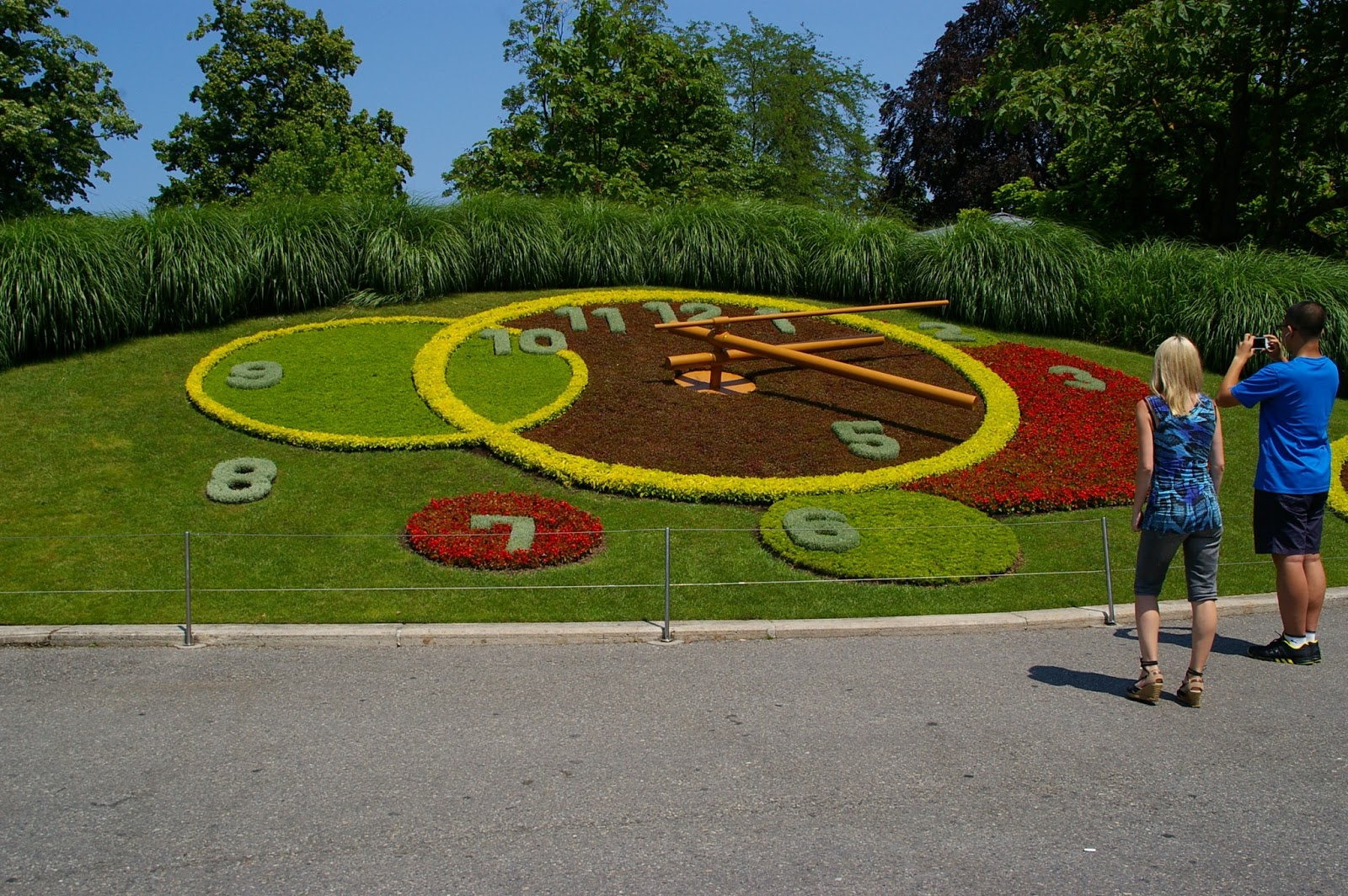
In the English Garden, Jardin Anglais, we found the famous floral clock, L’Horloge Fleurie, but were not terribly impressed with it.  It is very hot today and we both resorted to wearing hats to keep the sun off and drinking lots of water.


The main shopping streets are nearby but as we strolled through, we found they were a bit high priced for us.  Many of the shops were selling expensive watches and other high priced goods.  I don’t know who actually has the money to buy these things, but someone must.


The old town, Vielle-Ville, is just behind these streets and we climbed up the hill to see the cathedral amongst other buildings.  The cathedral is dedicated to St. Peter (Cathédrale Saint-Pierre) built between 1150 and 1230, originally Catholic, it is now a fine example of a Calvinist church. It became a protestant church in 1536 during the Reformation.  A wall dedicated to the Reformers, Guillaume Farel, Jean Calvin, Théodore de Bèze and John Knox is located a short distance away.  

Nearby was the Ancien Arsenal , the old city arsenal, and now the place where several cannons from the Napoleonic Wars are stored.  It was interesting to see the ornate decoration on these cannon.


Dinner tonight was at a small Italian restaurant near our hotel. We ate our meal while our clothes were in a dryer at a local Laverie, or Laundromat. There are just some things that just don’t happen by themselves, even when you are on holiday. The Laundromat is in the middle of the red light district. The ladies overtly apply their wares on the street. This made for some interesting viewing.

Monday, 8 July 2013

Interlaken to Montreux

Interlaken to Montreux

On board at Interlaken Ord
Another beautiful day finds us on the golden Pass Panoramic Train from Interlaken to Montreux.  

Views from the train on the journey
The train has huge windows dramatizes the view and intense colours of the lakes and mountains; the lakes are that opaque aqua blue of freshly melted snow, and the ice white peaks stand out against the clear blue sky, while in between the valleys are bright ,bright green.  From 567m the rail line rises to 1,274 m at Saanmoser then gently descends and rises to 1112m before a zigzag descent to Montreux. 
Our hotel
Freddie and Elizabeth

At Montreux, we walked straight off the train and across the street to our Hotel.  We have been given a brilliant room with a balcony, and we look across the street to the waterfront of Lake Geneva.  Our visit here coincides with the internationally famous Montreux Jazz Festival. We have always been intrigued by this festival so the opportunity to visit it was welcome.  The Festival runs from 5th to the 21sth July, and it extends along the waterfront, with market stalls and food stalls selling all sorts of ethnic foods.  We ate some Swiss fare for lunch, Doug managed another pork sausage, and we went back for a lovely helping of paella for dinner.


Paella stall
There are several spaces for free music events and several major paid events.  Green Day was headlining tonight, and Randy Crawford is on the next.  If you have a spare CHF395, you could get tickets to Prince for the 13th, 14th & 15th.  I imagine the tickets sold quickly for these events.  In the Park, where there was free music, we heard from ‘Jazz Juvenocracy’, a young US big band, and ‘Alice’ a Swiss Quartet which was very impressive and lovely to listen to. 

A taste of Montreux (the Swiss Riviera)
For dog etiquette 
We can now say we have been to the Montreux jazz Festival.  Been there – bought the t-shirt.

Interlaken and Jungfrau

Interlaken and Jungfrau
We breakfasted early as we had a big day planned and wanted to catch an early train to Jungfrau, the ‘Top of Europe’, at the same time hopefully avoiding the crowds of tourists who pour into the region.  Jungfrau has Europe’s highest-altitude railway station at 11,333 feet, or 3454 metres. The three high mountains of the Alps line up side-by-side: Eiger (3,970 m), Mőnch (4,107 m) and Jungfrau (4158 m).
Last section of covered track before entering main tunnel to top
Typical view on the way up - at Kleine Scheidegg Station
 Our journey began at Interlaken Railway Station where we took the train for Lauterbrunnen. From there we changed to a rack or cogwheel railway which took us slowly through an alpine scenic valley to Kleine Scheidegg, where we again changed trains, to another rack railway.  The track was very steep. We climbed slowly through a mountain tunnel to the top.  This train stopped twice for five minutes to allow passengers to observe the glacier through observation windows.
The glacier from the window at Eismeer Stop (3160m)
Construction for the railway tunnel began in 1896 following a vision by Swiss Industrialist Adolph Gayer-Zeller, to build a cogwheel railway to Jungfrau by blasting a tunnel through Eiger and Mőnch. Despite several setbacks, the railway was opened in February 1912, and last year celebrated its Centenary.  The railway is an amazing engineering feat.
The station at the top of the mountain had several levels.  The first thing we did was to catch a lift from the station to the top of peak, the Sphinx viewing platform (terrace), where we were able to go outside on the platform at 3,571 metres.  A weather station has been established here since 1922, but the public viewing area was only established in 1996. The lift took only 27 seconds to climb the 105 metres to the terrace. We had a full view down the Aletsch Glacier, and also of the tree peaks, Eiger, Jongfrau and Mőnch. On a clear day you can see the Vosges in France and the Black Forest in Germany.
Proof we were there
Looking over the 'glacier plateau' to the distance - dots are people
We descended again to the Tour level, which had a series of activities to keep the patrons occupied.  A 360° panoramic video of the mountains was playing as you walked through to the Alpine Sensation, a walk-through museum of the history of the railway, then to the Ice Palace.  
Walking through the ice cave
Sherlock Holmes in ice

This was a maze of tunnels carved into the glacier.  It was freezing inside with ice underfoot.  At various places, ice carvings were displayed featuring eagles, polar bears, seals and penguins and there was also a large carving of Sherlock Holmes.  Don’t ask me why?


We followed the Tour signs out to the ‘Glacier Plateau’ which was lower down from the Sphinx Platform. The ice underfoot was slushy and a little slippery in places and the glare of the ice was blinding so unless you were wearing sunglasses, you had to go inside quickly.  The lenses on our glasses turned almost black.  When we went inside later, I had to take my glasses off because they were too dark to see anything.  From here we had views of the three peaks and of the valleys below.  As the day was so clear, the view extended for miles. However, in the distance there was a dirty smog layer between the clouds and blue sky above (this is obviously where some of our pollution disappears to).
Looking from the glacier plateau towards entrance, restaurant levels, and at the top is the  Sphinx Terrace
The plateau was roped off, with warning signs about the danger of going beyond the ropes.  I watched as one bloke with a huge backpack climbed through the ropes and out onto the saddle platform of the peak.  I thought, “There always has to be one idiot who disobeys the rules”.  Next thing, he started to unpack his backpack, and he pulled out a paraglider chute.  He donned a crash helmet which had a camera attached to the top, taking his time as he carefully untangled the strings.  Once this was done, he attached the cords and strings to his frame harness, unfurled the chute, and very quickly launched himself off the cliff and into the air. We watched the process in awe.  Doug managed to get some good photos of him.
Ready
Set
Go!
We had lunch in the self-serve café.  The food was high fat, low nutrition but was all that was available.  Doug ate his longed for sausage and was very disappointed with the outcome.  The plates were loaded with French fries, but I at least had some vegetables on mine. Both plates had plenty of fries left on them.  
We wanted to catch the next train back so we hurried to the station.  Our companions on this leg of the journey was a friendly young couple, he from Perth, she from Brisbane.  You have to go around the world to meet your neighbours.  The journey each way totalled two and a half hours. 
At Kleine Scheidegg Station for next train to Grindelwald
Once more at Kleine Scheidegg, we were able to take an alternate train to Grindelwald where we got off and looked around the town for half an hour.  We then caught the next train back to Interlaken. This took us through a very pretty valley.  The fields, meadows and hillsides were absolutely abloom with wildflowers.  It would be a great place to walk and is very popular for walkers.

Grindelwald
If we went back to this area we would want more time to enjoy the large number of walks and see the other parts of the alps. They are immense and as you stand on the platforms you are immersed into it, and the frustrating part is that no matter how many photos you take, you can’t represent the dimensions. Viewing these photos back home with the projector on a large screen might help with this. For instance, it is only when you see some specks on the glacier floor (these are people) you get some idea of the scale.